
Digital Twins in Metal Stamping: Better Die Set Designs Before the First Cut
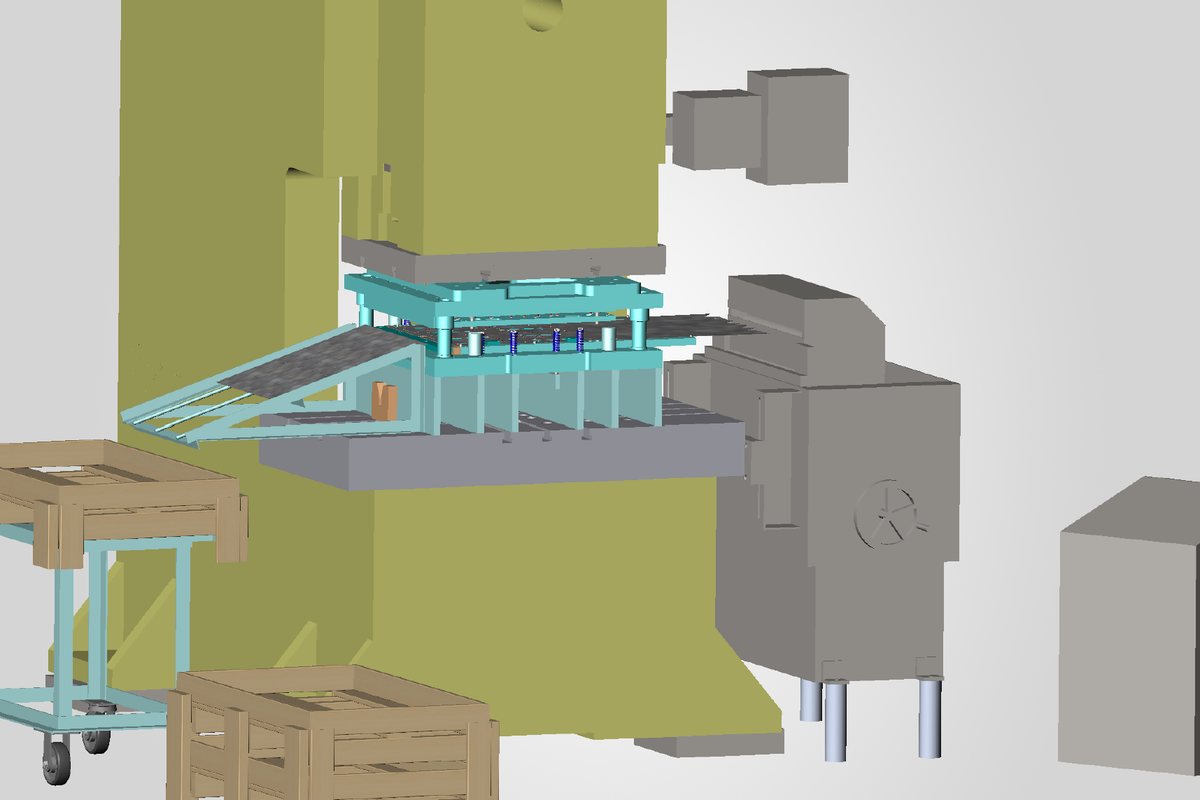
Shown is a simulation-enabled digital twin consisting of a stamping press with a die set installed, a feeder, controller, and virtual parts in a crate.
In metal stamping, the quality of a finished part often depends on decisions made long before a press starts running. Die set design plays a critical role in part accuracy, process consistency, tooling performance, and overall production efficiency. But traditionally, evaluating a die design can require significant time, engineering resources, and physical tooling.
What if you could test and refine a die set design without having to build it first?
What Is a Digital Twin?
A digital twin is a virtual representation of a physical product, system, or process. In manufacturing, it can be used to model how a design is expected to behave under defined operating conditions.
For metal stamping, a digital twin represents a die set, a press, raw material, feeder, and the interaction of transferring metal into a usable part. Our Tool Designer and Engineers can evaluate factors such as material flow, forming forces, deformation, clearances, and potential interference between tooling components.
Rather than relying exclusively on physical trials to determine whether a design will work as intended, FMS Tooling Designers and Engineers use the digital environment to investigate performance and refine the design before fabrication.
The key distinction is that a digital twin is more than a three-dimensional model. A 3D model shows what a die set looks like. A simulation-enabled digital twin helps engineers evaluate how the design is expected to perform.
How Digital Twins Improve Metal Stamping Die Design
1. Iterate on Designs Without Fabricating Physical Tooling
One of the biggest advantages of digital twin technology is the ability to explore multiple design iterations without building a new physical die for each one.
Engineers can evaluate alternative geometries, clearances, component arrangements, and other design parameters in a virtual environment. When a simulation reveals an opportunity for improvement, the design can be adjusted and evaluated again.
This creates a more flexible engineering process. Instead of treating every design change as a potentially expensive tooling modification, engineers can investigate alternatives digitally and narrow the options before fabrication begins.
The result is a more deliberate approach to die design, with physical tooling built around a design that has already undergone virtual evaluation.
2. Identify Potential Problems Earlier
Design issues discovered after tooling has been manufactured can be costly to correct. Depending on the problem, changes may require CNC machining, wire EDM (Electrical Discharge Machining), component replacement, additional engineering time, or another round of tryout and testing.
By evaluating the design under simulated operating conditions, Tool Designers and Engineers can investigate potential interference, excessive forming loads, material deformation, and other process-specific concerns.
Finding these problems during virtual development gives the engineering team more options. Changes can be made while the design is still digital, rather than after time and money have been invested in physical tooling.
3. Reduce Tooling Development Time and Cost
Every physical tooling iteration requires resources. Engineering changes, machining, assembly, setup, and press tryouts can all add time and expense to the job.
When FMS Tool Designers perform more of their design evaluation virtually, they can reduce their reliance on repeated physical iterations. Physical iterations are still necessary, but they are minimized with better designs.
Working across multiple customer programs, improving the efficiency of tooling development can help free up engineering capacity, reduce avoidable rework, and support more predictable part production schedules.
4. Improve Part Quality and Process Confidence
A well-designed die set is essential to producing consistent stamped parts. Small design decisions can influence how material forms/deforms, how loads are distributed, how holes are pierced/punched and how the tooling performs during operation.
Digital simulation allows engineers to evaluate these relationships before production begins. They can compare design alternatives, examine predicted behavior, and make adjustments based on the results.
5. Make Better Engineering Decisions
Traditional tooling development involves trade-offs between performance, complexity, cost, and manufacturability. Evaluating every possible alternative physically is not practical.
A digital twin makes it easier to compare options in a controlled environment. Engineers can change designs, examine the resulting simulation outputs, and use those findings to guide the next iteration. This creates an opportunity to make decisions based on engineering analysis rather than relying solely on experience or trial and error.
From Virtual Design to Physical Production
Digital twin technology does not mean eliminating physical tooling or the need for real-world testing. The goal is to make the transition from design to production more informed and efficient.
Frontier Metal Stamping's workflow looks like this:
-
Review Customer's 3d virtual geometry files: Often times, parts designed in SolidWorks by our customers do not have correct K-factors and may not have been designed in SolidWorks sheet metal. The files are typically missing the internal manufacturing metadata required to generate a flat pattern. Getting the 3D geometry of the part is critical. During this step grain direction and material flow are key considerations.
-
Design the Strip: Each step of the progression needs careful consideration. Potential deformation, tolerances between features, features of the part in proximity to the edge of the strip or in close proximity with each other, the possibility of having multiple parts etc. all determine the material usage. The goal is to get the most out of the raw material and minimize scrap. High volume production will accentuate decisions made in this step.
-
Design the die set. A FMS Tooling Designer creates a virtual representation of the proposed die set, stroke height, press geometry, and considers press tonnage, cycle times, material properties, etc. The output is a first shot at a virtual die set.
-
Simulate performance in a press. The Tool Designer and Builders evaluate how the design is expected to behave running through a press.
-
Refine the design. Adjustments to components and/or design parameters are made based on the virtual findings and additional iterations are made to the design.
-
Prepare for fabrication. Once the Tool Designer is comfortable with the design, 2D part drawings are created and moved into physical tooling development. Enter, CNC machining, Wire EDM, grinding, polishing, etc.
-
Validation. We manufacture the die set, assemble all the components in the punch holder and die shoe, bring the die set together, set up the raw material to run parts, measure the stamped parts, and compare physical parts with the print. And then Step and Repeat cycles are performed until the parts are to print.
This approach brings more analysis into the early stages of tooling development, where design changes can often be made more easily.
Why Digital Twins Matter for a Metal Stamping Job Shop
For a metal stamping job shop, every new part presents its own combination of part geometry, material requirements, stresses, tolerances, production demands, and tooling considerations.
Digital twins can help a job shop:
-
Reduce unnecessary tooling rework by evaluating more design alternatives before fabrication.
-
Improve development efficiency by moving design refinement into the virtual environment as much as possible.
-
Support consistent quality through earlier analysis of potential process and tooling issues.
-
Make better use of engineering resources by reducing dependence on repeated physical design iterations.
-
Strengthen customer confidence by demonstrating a structured, engineering-driven approach to die-set development.
These benefits are particularly relevant when parts have demanding specifications, complex forming requirements, or limited time for tooling development.
The objective is not simply to create a digital model. It is to use that model to make better engineering decisions and improve the path from customer requirements to production-ready tooling.
Why Digital Twins Matter for Frontier's Customers?
Bottom Line: Our customers benefit greatly from Digital Twin Designs. Customers enjoy time-to-market acceleration; lower tooling costs and piece part pricing; and enhanced piece part quality. Interested in learning how virtual die design can support your next metal stamped part? Contact Jonathan Hall, Business Development, Frontier Metal Stamping ([email protected]).
More from the shop

What is Precision Tooling? Understanding the Backbone of Modern Manufacturing
An explanation of precision tooling, the benefits accurate tooling brings to quality, efficiency and scalability, and how Frontier handles design through production.Read more
The Advantages of Metal Stamping: How It Works and Why It Matters
An overview of how metal stamping turns flat sheet into finished parts, plus the precision, cost, speed, material and waste advantages that make it a manufacturing favorite.Read moreHave a print to quote?
Send it over and we will tell you what it takes to make it.
Open Monday through Friday.